Navigation
About Sociology x Product Work Writing Work With Me
Sociology x Product

Product problems are social problems in technical clothes.

A longform guide to the social mechanisms standard PM frameworks miss: norms, identity, structure, network position, and value flow. Built for product leaders who keep finding human problems underneath clean dashboards.

This is the anchor page for the lens itself. Start here for the conceptual frame, then move to the essays for depth or the field guide for a meeting-ready tool.

Anchor page Five models For product leaders
Use This When
a clearly useful feature still will not spread
the metric moves but trust or quality gets worse
the team keeps solving the right problem at the wrong layer

The blind spot in product management

Product management inherited its strongest tools from engineering, economics, and psychology. Those traditions are useful, but they share a bias: they tend to explain behavior at the level of the individual actor. The user wants something. The user understands or does not. The user is motivated or not. The user converts or drops.

That framing is often too thin for the problems product teams are actually facing. Products do not live inside isolated decisions. They live inside social systems. People act in front of audiences. They compare themselves to peers. They read signals about status, safety, legitimacy, and risk. They move through institutions and constraints they did not choose. They create value for companies while absorbing costs that rarely show up on dashboards.

Once you change the unit of analysis from the isolated user to the social system around the user, different questions become obvious. Those questions do not just enrich the diagnosis. They often reverse it.

Framework · Default PM vs Sociology x Product
Default PM model

User as individual

  • Behavior is a decision.
  • Friction lives in the interface.
  • Growth lives in the funnel.
  • Value is what the company can measure.
Sociology x Product

User in a social world

  • Behavior is shaped by norms and audiences.
  • Failure can live in exposure, structure, or power.
  • Growth is diffusion through networks.
  • Value is distributed and often externalized.
The product can stay the same while the diagnosis changes completely. The first question you ask determines which solution you are allowed to see.

The recurring misread

The same category errors show up repeatedly in product work. Teams call something a UX problem when it is a stage problem. They call it low motivation when it is structural constraint. They call it noisy data when the metric itself encodes the wrong theory of value.

These are not semantic mistakes. They decide what the team does next. And once the wrong diagnosis takes hold, even good execution compounds the mistake.

They call it an onboarding problem. The barrier is social risk before the click.
They call it low motivation. The behavior is structurally unavailable.
They call it noisy data. The metric is hiding the wrong theory of value.
They call it product-market fit. The product may have authority without legitimacy.
They call it engagement decline. The social cost of the system is becoming visible.

Five models to reach for before you reach for a fix

These are the models I would want in the room before choosing an intervention. They are not comprehensive sociology. They are compact diagnostic tools for product work. The job is not to sound theoretical. The job is to stop solving the wrong thing.

01 / The social adoption funnel

The dashboard starts too late.

Most funnels begin at action. They count the click, the signup, the post, the invite, the conversion. But for any visible behavior, the decisive questions usually happen earlier: what does this make me look like, who is watching, do people like me do this, and what if I get it wrong?

That is why clearly useful products can stall even when the interface is good. The product is ready. The user is not yet socially ready. The act feels too exposing, too presumptuous, or too identity-threatening to become normal.

Use it when: adoption stalls on a public or identity-laden act such as profile creation, contribution, sharing, disclosure, or collaboration.

Standard PM says: reduce friction. This model asks: what happens before the user ever reaches the button?
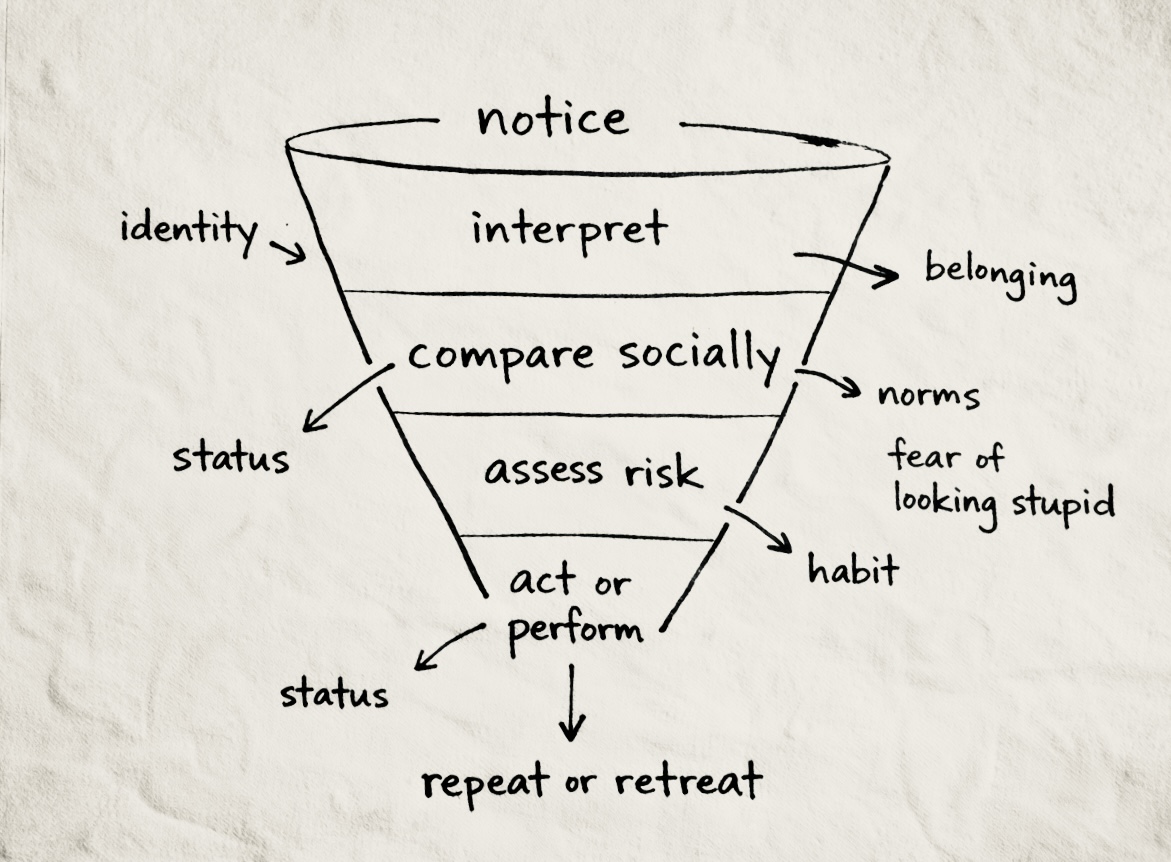
Notebook sketch showing the social stages that precede action in an adoption funnel.
Adoption is often decided during interpretation, comparison, and risk assessment, long before the funnel logs a drop-off.
02 / The behavior system

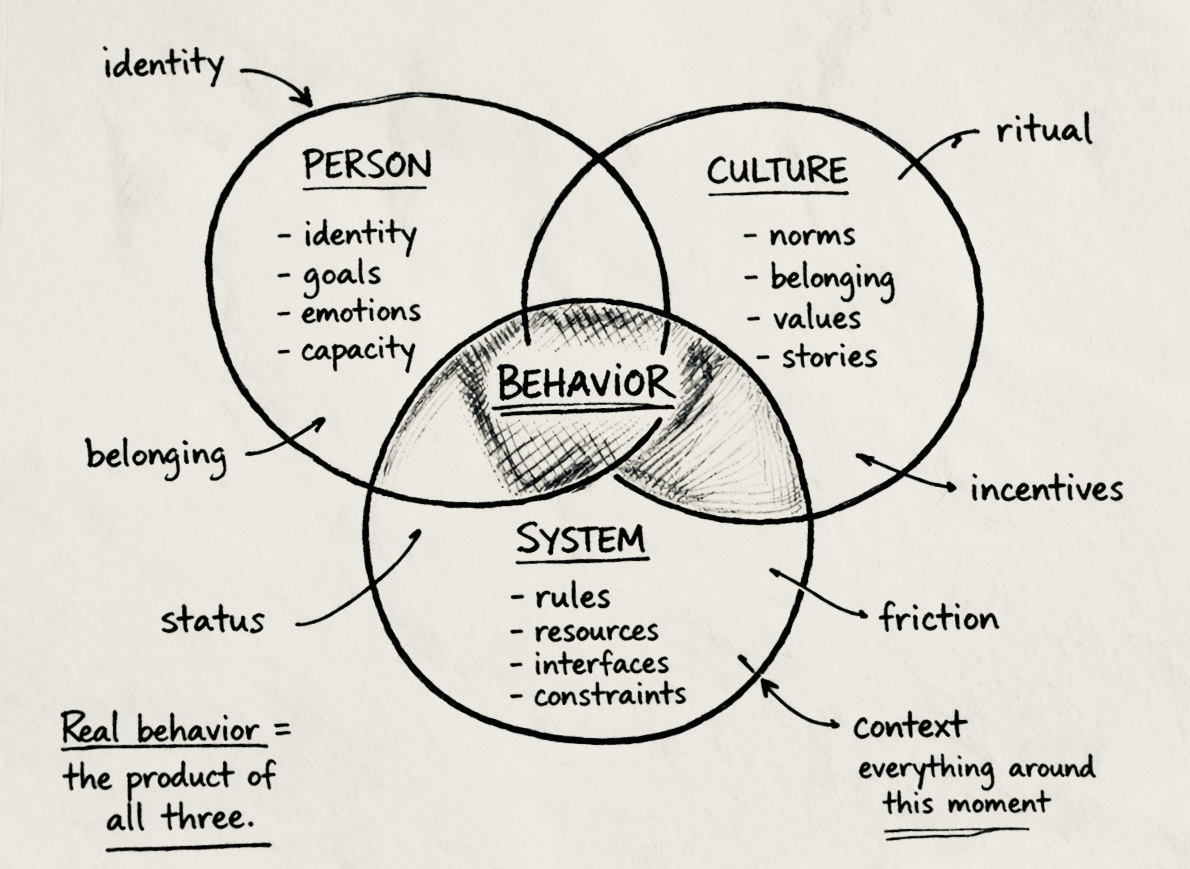
Behavior sits at the overlap of person, culture, and system.

Notebook sketch showing behavior as the overlap of person, culture, and system.
Most teams over-index on system because that is what they can ship. But behavior often breaks because culture and status are doing more work than the interface.

When a behavior does not happen, teams often jump between two stories: users do not want it, or the product made it too hard. Both can be true. Both can also be wrong. A more useful starting point is to ask which part of the behavior system is broken: person, culture, or system.

Person is motivation, confidence, and ability. Culture is norms, identity, and what feels socially allowed. System is the product itself: the interface, incentives, and constraints the team actually controls. A good diagnosis names all three before deciding which one matters most.

Use it when: the team keeps toggling between "users do not want it" and "the flow is confusing" without explaining the social context in between.

Standard PM says: fix motivation or UX. This model asks: which layer is actually blocking the behavior?

03 / Structure before motivation

Before you call it low motivation, ask whether the choice is real.

A great deal of product work quietly assumes that users can do the thing if they want it badly enough. Sociology asks the harder question first: can they actually do it? Time, money, social permission, network position, institutional rules, and risk outside the product all shape what is available before preference enters the picture.

This matters because product teams have many motivation tools and far fewer structural tools. It is easier to rewrite copy than to acknowledge that the behavior is expensive, risky, or impossible in the user’s actual life. So teams keep trying to motivate behavior that is structurally blocked.

Use it when: the desired behavior depends on disposable time, public vulnerability, economic slack, trust, or institutional permission that users may not have.

Standard PM says: users are not motivated. This model asks: is the user unwilling, or simply unable under current conditions?

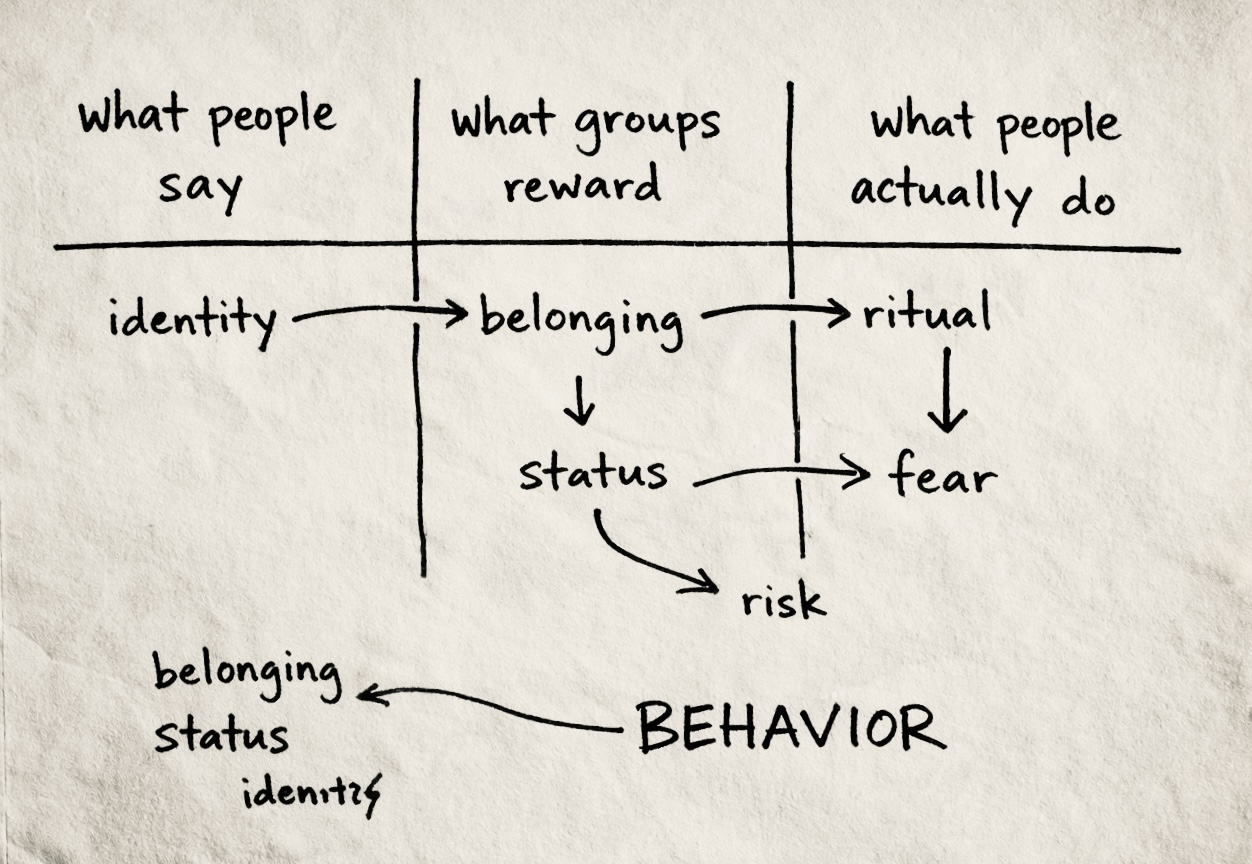
Notebook sketch contrasting genuine preference with behavior shaped by conditioning or constraint.
What looks like preference is often a record of what was available, affordable, safe, or socially permitted.
04 / The metric is a social claim

Every metric hides a theory of what counts.

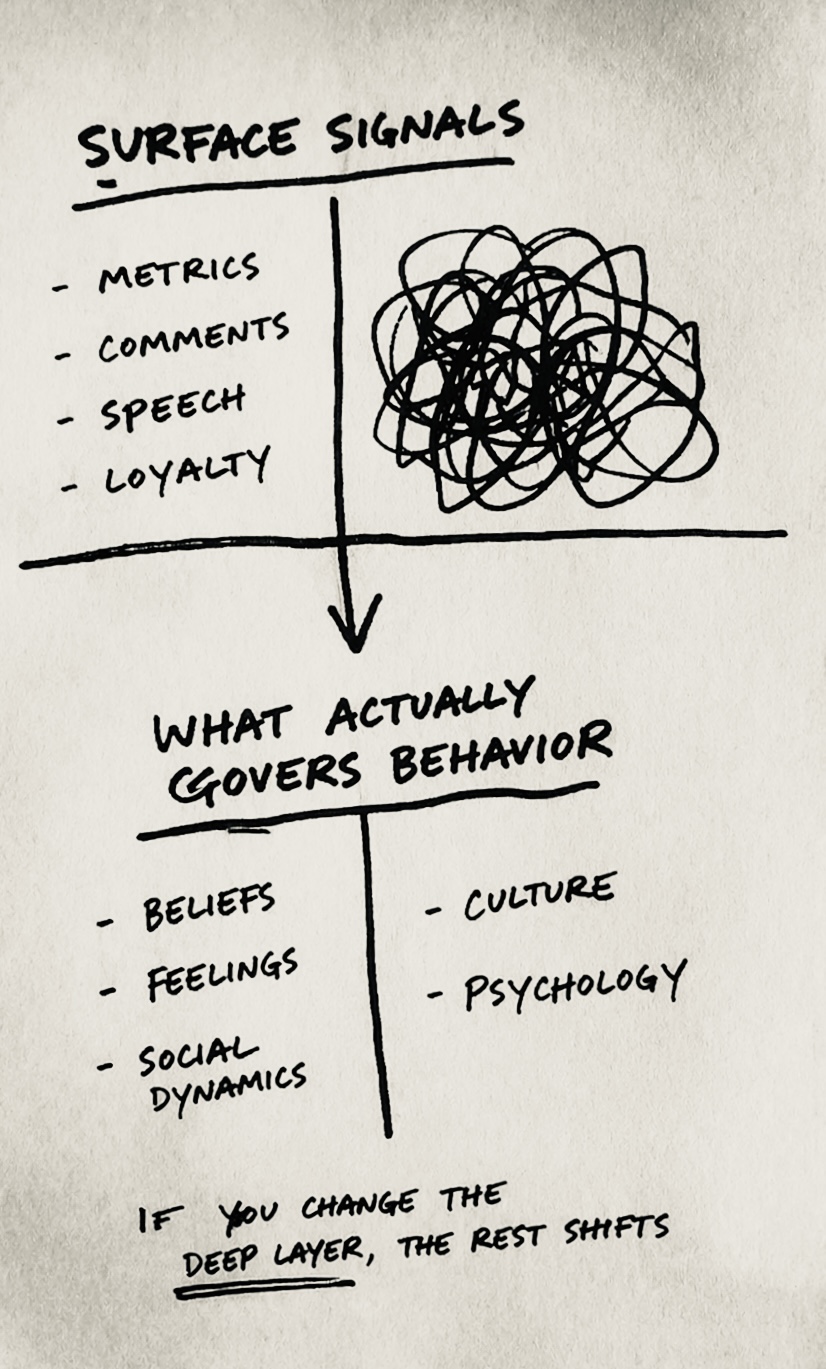
Notebook sketch contrasting surface signals with the governing forces that sit underneath them.
Metrics sit on the surface. The governing logic underneath them is where misdiagnosis begins.

Goodhart’s Law is only part of the problem. Long before a measure gets gamed, it already carries a theory of value. It says what matters, whose behavior counts, which experience is visible, and which trade-offs can be safely ignored.

That is why teams can optimize a metric with real rigor and still move away from the thing they actually care about. The number was never neutral. It was already an argument about the product and the social world around it.

Use it when: a number is moving while trust, quality, fairness, or usefulness seem to be moving in the opposite direction.

Standard PM says: make the metric healthier. This model asks: what theory of value is the metric enforcing, and what does it make invisible?

05 / Value flow

Every product decides who creates value, who captures it, and who absorbs the cost.

Value creation is only part of the story. Products also route value, extract it, and push costs somewhere. Sometimes those costs land on workers. Sometimes they land on users in the form of privacy loss, emotional labor, or cognitive load. Sometimes they land on communities that were never represented in the strategy review at all.

Once you map value this way, “ethics” stops looking like a late-stage overlay. It becomes a strategy question from the beginning. A product can look elegant precisely because somebody else is holding the mess.

Use it when: convenience, scale, or growth appears to depend on invisible labor, hidden harm, or off-platform cost bearing.

Standard PM says: the product is working because the dashboard is healthy. This model asks: who is doing the work, who is taking the upside, and who is carrying the cost?

Framework · Create value / Capture value / Absorb cost
1 · Create value

Users, workers, creators

Labor, attention, data, content, trust, and coordination.

2 · Route value

Platform logic

Ranking, matching, pricing, policy, defaults, and workflow decisions.

3 · Capture value

Company and buyers

Revenue, convenience, efficiency, and market power.

Hidden labor Moderator trauma Gig-worker precarity Privacy loss Civic cost
The missing question in many strategy reviews is simple: who absorbs the cost when the dashboard looks clean?

What this lens predicts before the dashboard does

Once you start looking at products as social systems, certain failures stop being surprising. What looked like random turbulence begins to read like a pattern.

Social adoption funnel

Facebook’s sharing problem was not just feed ranking. It was stage exposure.

As family, coworkers, old classmates, and close friends collapsed into one audience, posting became harder to perform. The product looked functional. The social cost of using it changed underneath the interface.

Read the essay
Behavior system

Nextdoor reduced racial profiling reports by 75% by changing the conditions of the act.

The intervention did not simply add moderation after the fact. It reintroduced friction and specificity into the behavior itself, changing what the system made easy and socially invisible.

Read the case
Value flow

Ghost work explains why AI products can feel magical while labor remains invisible.

The clean user experience is often made possible by hidden human effort elsewhere in the system. Once you map value flow, that invisibility stops looking incidental and starts looking strategic.

Read the essay
Authority and legitimacy

A product can reach millions through authority and still be socially fragile.

Aarogya Setu scaled with extraordinary speed, but trust still had to be earned. Velocity is not the same as legitimacy. Distribution can create adoption before social durability exists.

Read the case study
How to use this work

Start here. Then take it into the room.

This page gives you the lens. The essay series gives you the arguments in depth. The field guide turns the models into a practical tool for reviews, postmortems, and strategy sessions.

Why this exists

Product management already has a language for prioritization, experimentation, and execution. It does not yet have a strong enough language for the social systems products enter and create. That gap becomes more costly as products become infrastructure.

This page is meant to be that missing bridge: rigorous enough to change the diagnosis, practical enough to use in the room, and opinionated enough to be worth passing around.